

Climate mitigation
GHG inventories and emissions pathways
Greenhouse gas inventories, emission reduction pathways and targets, and the costs and benefits of each mitigation option.
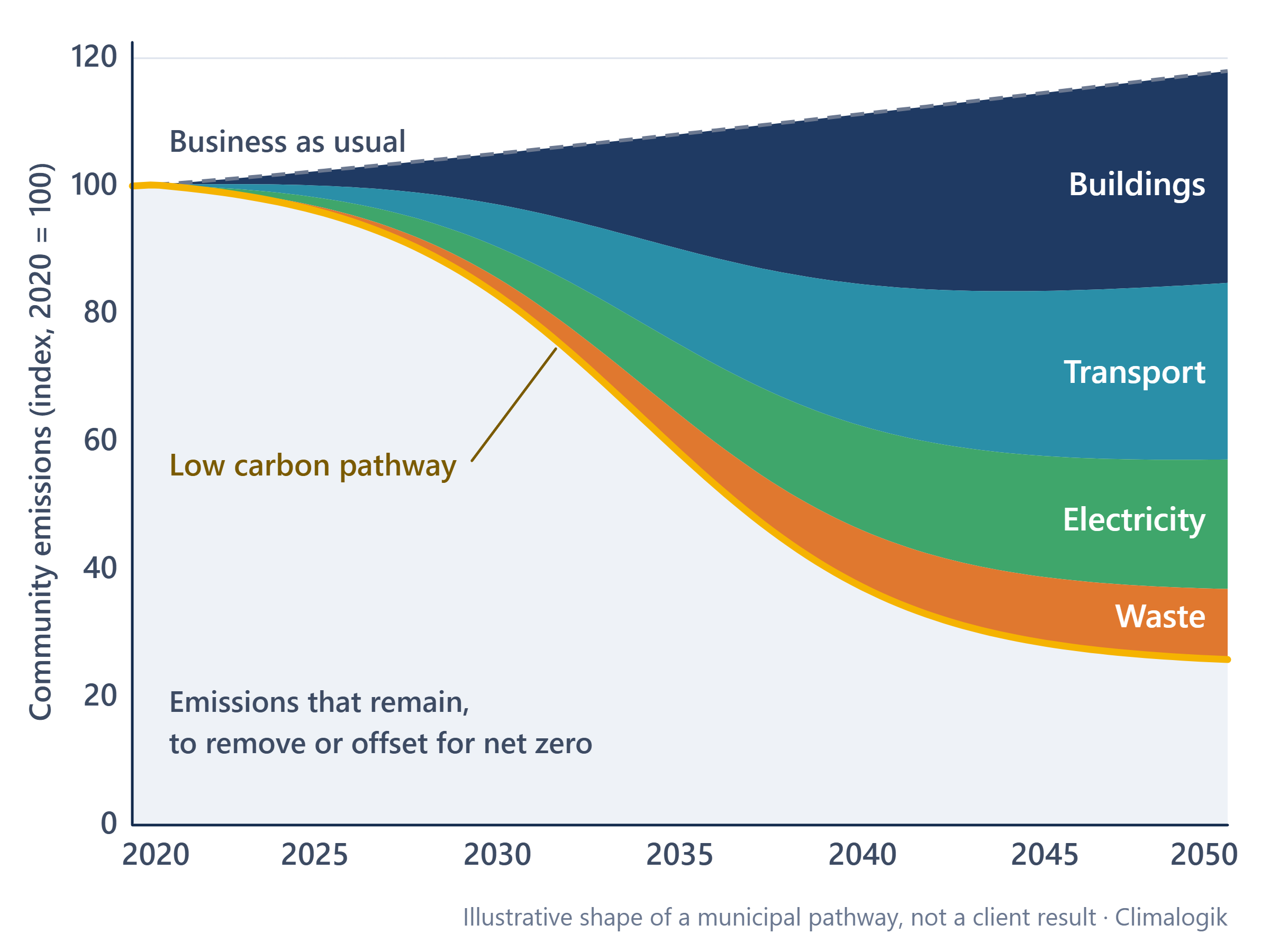
The reductions a target requires
Integrated modelling of greenhouse gas emission reductions to support the shift to a low-carbon economy.
We explore the greenhouse gas emission reductions necessary to achieve long-term local, regional, national, and global climate goals, such as the Paris Agreement goals of holding warming well below 2 °C and pursuing 1.5 °C above pre-industrial levels. By analyzing emissions scenarios from energy-economic models, as well as associated time- and pathway-dependent mitigation costs and technology portfolios with coupled carbon-cycle/climate models, Climalogik employs a combined science and practice lens to help Indigenous Peoples, municipalities, provincial, territorial, and federal governments act on Canada’s national targets of a 40 to 45% reduction in greenhouse gas emissions below 2005 levels by 2030 and 45 to 50% by 2035, on the path to net-zero emissions by 2050, and to enable sustainable economic growth.
The Canadian Net-Zero Emissions Accountability Act (2021) legislates Canada’s commitment to net-zero emissions by 2050 and sets national targets at five-year milestones, each with an emissions reduction plan. The 2030 Emissions Reduction Plan sets out measures to achieve reductions across all sectors of the economy, and Canada’s Climate Competitiveness Strategy (2025) complements it with industrial carbon pricing, clean investment tax credits and carbon contracts for difference, to ensure Canadian businesses are competitive in the global low-carbon economy. Current projections fall short of the 2030 and 2035 targets, which puts more weight on credible, costed pathways. The National Adaptation Strategy (2023) advances climate change adaptation and builds resilience to climate impacts across the country.
Our experienced multidisciplinary team combines technical climate science, economic policy, sustainable development, and strategic insights to help our clients meet their emission reduction targets, as detailed in municipal, provincial, territorial, Indigenous and federal climate plans.
Where emissions and climate risk are planned together, we deliver the work with our Low Carbon Resilience partners.
What we do
- GHG inventories and standards-based quantification. Community and corporate inventories and reporting.
- Emissions pathways and scenario modelling. The reductions, by sector, that meet a target.
- Carbon and emission budgets. What a temperature limit or target leaves to emit.
- Costs and co-benefits of mitigation. Including air quality co-benefits.
- Climate Lens GHG mitigation assessments. For federal infrastructure funding, including the GHG assessments that newer programs require.
- Assessment of reduction targets and opportunities. What is achievable, by when.
- Compliance and forecast reporting under carbon pricing systems. For regulated facilities.
What you receive
- Corporate and community GHG inventories
- Reduction pathways to a target year
- The cost and trade-offs of each low carbon option
Methods
We choose methods to fit the target and the jurisdiction, such as:
- GHG Protocol, GPC and ISO 14064 inventory methods
- Scenario modelling
- Comparative cost and trade-off analysis
Also covers: Greenhouse gas (GHG) emissions inventories · Standards-based GHG quantification and reporting · Emission reduction targets · Carbon and emission budgets · Economic modelling of GHG emission reductions · Cost-benefit analysis of mitigation options · Costs of greenhouse gas mitigation · Climate economics · Co-benefits of climate change mitigation · Air pollutant emissions · Climate Lens GHG mitigation assessment · Emissions compliance and forecast reporting · Low carbon economy and innovation · Paris Agreement 1.5 °C and 2 °C pathways
Questions we help answer
- What are our emissions today, and where do they come from?
- What reductions does our target require, by sector and by year?
- What will each reduction option cost, and what are its co-benefits?
- What does a Climate Lens GHG mitigation assessment of this project require?
- How do our targets compare with provincial and federal targets and the Paris Agreement?
The work
Adaptation + mitigation
City of London: Low Carbon Resilience Implementation Program
Dufferin County
City of Swift Current
Discuss your project
Start with a 30-minute call with a climate scientist about your question, your data and your timeline.