

Climate adaptation
Statistical analysis and climate analytics
Supporting climate adaptation and mitigation efforts with expertly modelled, analyzed and interpreted climate projections.
The right data for the right purpose
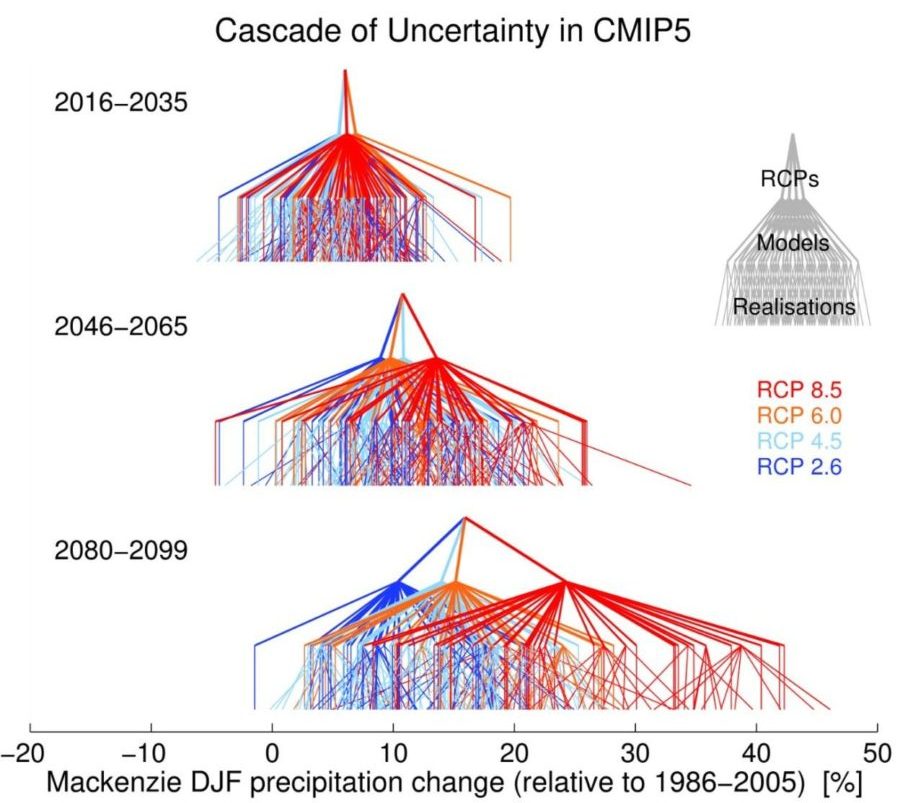
Although climate models are constantly being improved, they cannot predict future climate conditions with a degree of confidence that would allow precise adaptation decisions to be made. Uncertainties in natural climate variability, future society, the scale of future greenhouse gas emissions, and scientific knowledge of how components of the climate system interact all lead to uncertainty in climate projections. Outputs from different climate models can disagree on both the size and the sign of change in a climate variable, presenting users with a wide range of possible climate futures.
Should engineers choose and use what they regard as the best projection? Or should they use all the projections to build infrastructure that is prepared for anything that may come, even though it may prove more costly? The growing demand to anticipate the future impacts and costs of climate change challenges the practice community, since projections of climate change impacts should rest on robust and reliable climate input. To estimate the range of possible future design values, a balanced and unbiased estimate of the entire distribution of possible future changes is required. This range is often estimated by driving impact models with a few selected climate scenarios, the selection being largely subjective or determined by practical reasons such as availability. Such practice can bias the results, or leave the pertinent uncertainties unaddressed, and lead to a poorly informed adaptation response.
There are many types of climate change projection data, and choosing the right data for the right purpose is an important part of any impact assessment. At Climalogik, we develop project-specific statistical and analytical tools for selecting the climate input for impact assessments more objectively, to avoid sampling biases, properly account for uncertainties and save computational resources. Data are acquired by taking measurements, reviewing historical records, producing climate model output, or examining indirect (proxy) records such as tree rings. For every project, we gather the required data or work with the data you provide.
What we do
- Model and scenario selection. Approaches such as performance- and spread-based selection, screening on climate sensitivity (the “hot model” issue) and Bayesian model averaging, with scenarios matched to the decision, from SSP1-2.6 to SSP5-8.5.
- Uncertainty analysis. Ensemble ranges, model agreement, the part played by natural variability, and a confidence statement for every result.
- Large multidimensional datasets. Analysis and visualization of ensemble archives on high-performance and cloud computing.
- Short design lives. For assets that will be replaced within a decade or two, observed trends and natural variability weighed alongside near-term projections.
- Univariate and multivariate climate time series analysis
- Analysis of diurnal, seasonal and interannual climate variability
- Integration of climate data sources and indices into risk assessment frameworks
- Development of climate risk assessment software
Also covers: Bias correction of climate projections · Bayesian model averaging · Selection of climate scenarios and models · Identification of project-based planning horizons, such as the 2050s and 2080s · Statistical analysis of large climate datasets · Climate analytics
Questions we help answer
- Should we design for one “best” projection, or for the full range of projections?
- Which climate models and scenarios suit this decision, and how many do we need?
- How certain are the projections, and where do the models disagree?
Related: Climate data, downscaling and projections · Weather, meteorology and climate baselines · Data science and geospatial analytics · All services
Discuss your project
Start with a 30-minute call with a climate scientist about your question, your data and your timeline.