

1st
PIEVC Green assessment in Iraq
500,000
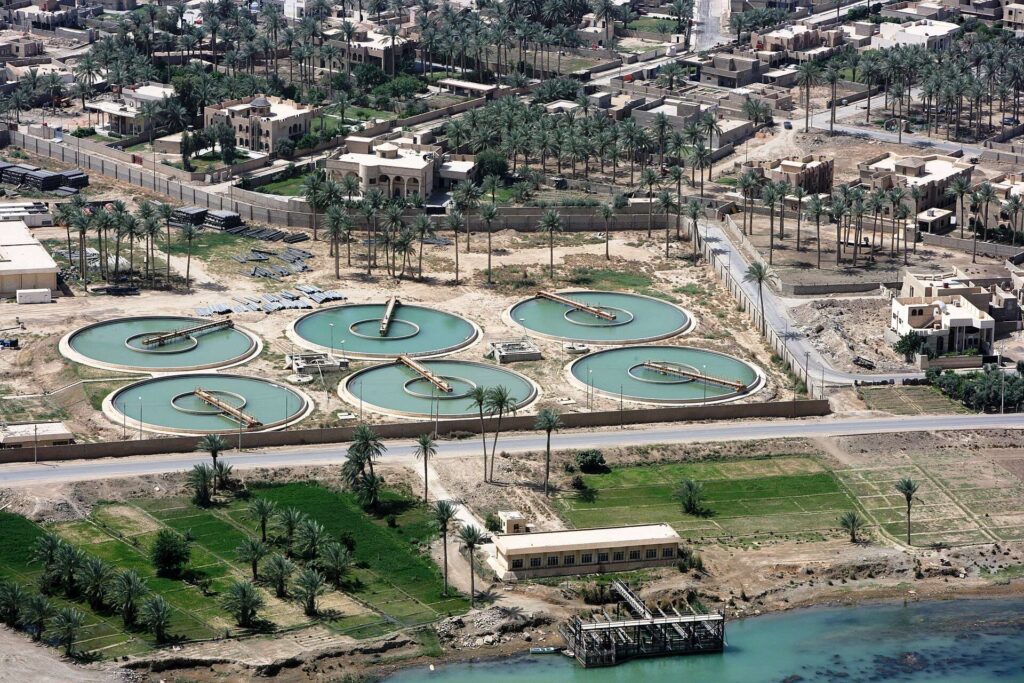
residents served by the Ramadi plant
5
climate summaries: four governorates and the Ramadi plant
+70
heatwave days a year at Ramadi by the 2050s
The question
Iraq’s water treatment plants were designed for a climate that has since changed. Under Iraq’s decentralization law, governorate authorities hold responsibility for drinking water. GIZ and the Climate Risk Institute asked how those authorities can assess climate risk to their water infrastructure and act on it, starting with a plant that supplies half a million people.
What we did
As climate lead for the project, Climalogik assessed the climate data available for Iraq, built the climate baseline and projections for four governorates (Al-Muthanna, Al-Qadisiyyah, Thi-Qar and Wasit) and for Ramadi in Al-Anbar, and produced the climate analysis and likelihood scoring for the PIEVC Green assessment of the Ramadi drinking water treatment plant in Al-Anbar, the first application of the PIEVC Green Protocol in Iraq.
Using the RICCAR Mashreq ensemble (six CMIP6 models downscaled with HCLIM-ALADIN to about 10 km and bias-corrected against ERA5-Land) under a high-emissions pathway (SSP5-8.5), we projected extreme heat, drought and short-duration heavy rainfall for the 2030s and 2050s, and scored the likelihood of each climate-infrastructure interaction with Iraqi engineers and operators. We also contributed the climate content of the national guide for climate-resilient drinking water infrastructure.
- RICCAR Mashreq projections
- ERA5-Land
- PIEVC Green
- Likelihood scoring
What GIZ and the directorates received
- A climate data needs and sufficiency assessment for Iraq
- Climate summaries for four governorates and for the Ramadi plant, under a moderate and a high emissions pathway, in a form directorates can use directly
- The Ramadi plant’s PIEVC Green assessment: a scored risk register across grey, natural and social infrastructure, and three adaptation scenarios screened on a triple bottom line
- A national guide for climate-resilient drinking water, aligned with Iraq’s NDC and National Adaptation Plan
What changed
Ramadi’s operators and the Al-Anbar directorates have a ranked picture of what fails first as the climate changes: drought-driven intake and water-quality problems, heat stress on filters, pumps and chlorination, and flash-flood turbidity. The projections show about 30 more heatwave days a year by the 2030s and more than 70 by the 2050s, and the heaviest day of rain about a third heavier by the 2030s. The method is written into a national guide so other governorates can repeat it.
Hazards assessed
- Extreme heat and heatwaves
- Drought and water scarcity
- Inland flooding
Related service
We provide the climate analysis and likelihood scoring for PIEVC, PIEVC Green and Climate Lens assessments.
Discuss your project
Start with a 30-minute call with a climate scientist about your question, your data and your timeline.