

Climate adaptation
Climate risk and vulnerability assessment
For a community, a government or an asset portfolio: a scored risk register and adaptation priorities, with every score traceable to the data behind it.
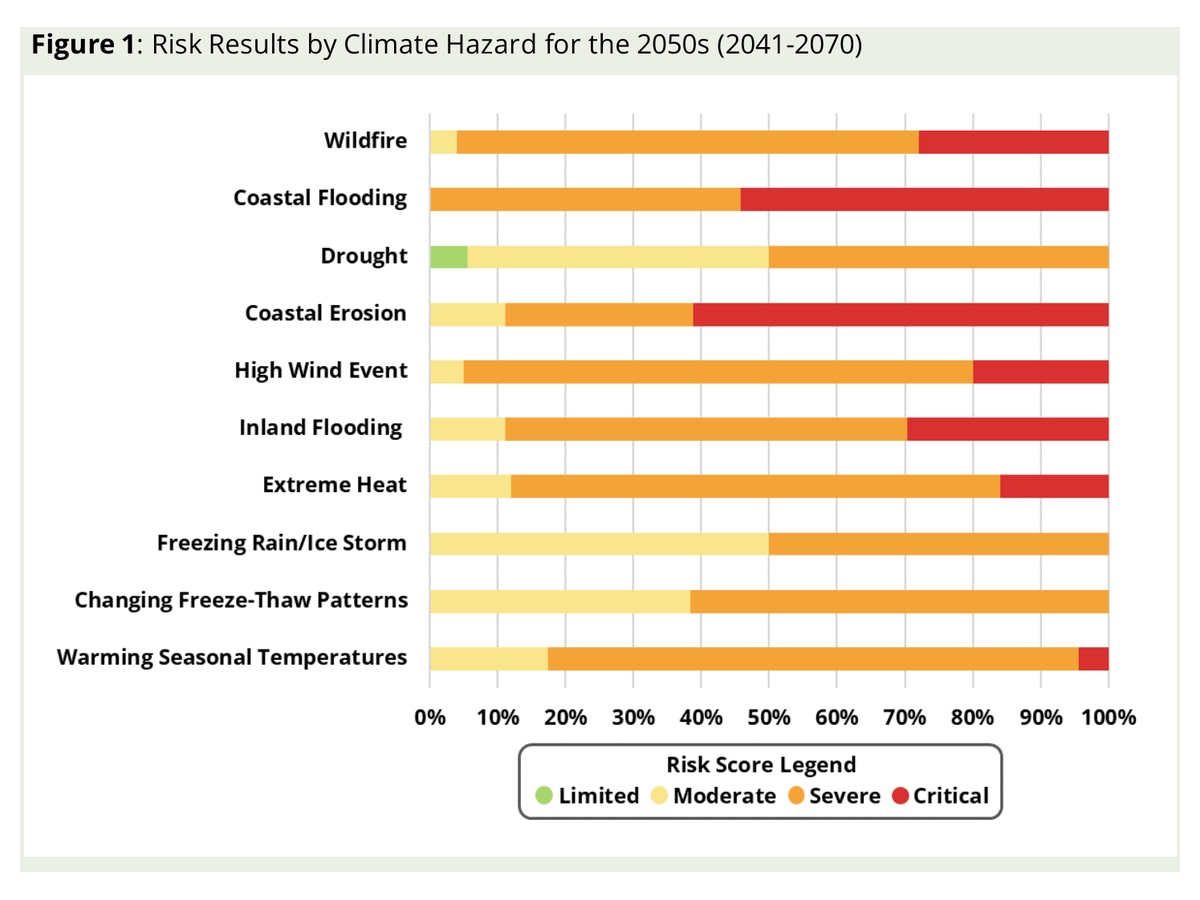
Evidence funders and insurers look for
Building community and business resilience in the face of climate and global environmental change.
Climate change presents growing threats and uncertainty to communities and businesses. Climate change vulnerability and risk assessments are an important step in identifying appropriate adaptation measures. In practice, a more detailed assessment is likely to require high-resolution maps and specific local area models, and technical specialists need to define clearly the level and resolution of data required to analyze the issues sufficiently.
Federal infrastructure funders, public financial institutions, commercial banks and insurers increasingly want evidence that developers of physical assets and infrastructure have integrated climate resilience and mitigation measures into a project as a prerequisite for funding or insuring it. Disclosure standards such as IFRS S2 and Canada’s CSDS 2 set out how organizations report their physical climate risks. Governments and development agencies have invested considerable effort in methods and tools, such as the PIEVC Protocol and ICLEI Canada’s BARC methodology, to screen projects for the risks posed by climate change. Applying these tools well within actual project settings still requires specialist climate expertise.
As awareness increases, so does the need for capacity building and training. In many cases, communities are held back not by a lack of will but by a lack of the technical expertise and knowledge needed to plan and put the necessary initiatives and policies in place. The desire for positive change is there, but the ability lags behind. Guidance and the transfer of know-how are therefore critical as provinces, territories and communities prepare to tackle the impacts of climate change. With the appropriate tools, decision-makers are better equipped to integrate development and climate change and produce effective risk management plans.
Climalogik’s work focuses on enhancing the climate resilience of communities, integrating climate adaptation into corporate and institutional planning, and formulating science-informed, evidence-based adaptation action plans. We conduct strategic climate risk and vulnerability assessments of a range of infrastructure assets, such as transportation systems, energy infrastructure, water and wastewater systems, information and communication technology systems, and buildings. We develop and apply adaptive risk assessment frameworks to identify region-specific climate change impacts and to assess the key risks, vulnerabilities and opportunities that climate change could bring. Doing so lessens the costs of these changes to governments, municipalities, Indigenous communities, businesses and families, and increases resilience to future climate impacts. We provide actionable climate data and information that support decision-makers in making decisions that promote low-emission, climate-resilient development.
Who it is for
Municipalities
Assets, services and a council that needs priorities
Indigenous governments
Communities, lands and ways of life
Provinces and territories
Sectors and systems across a jurisdiction
Asset owners
Portfolios to rank and single assets to check
What you receive
- A scored risk register: every hazard against every asset, service or system, with likelihood, consequence and rating
- Hazard and exposure maps for your jurisdiction
- Ranked adaptation priorities
- A council-ready summary and the full technical report
- The data and method behind every score, so your team can trace it
- Optional: your results on a Climate Map residents can explore
How we do it
- ScopeThe decisions ahead, the assets and services in scope, your risk matrix, and the framework you work in.
- Climate and hazardsScenarios and models chosen for your horizons; downscaled projections and hazard indices for the baseline and the future.
- Exposure and vulnerabilityWhat is in harm’s way and how sensitive it is, with Indigenous Knowledge where a Nation chooses to share it.
- Likelihood and consequenceLikelihood scored from the climate indices against your thresholds; consequence scored with your staff, on your scale.
- Risk and prioritiesRisks rated, including compound and cascading risks, hotspots found, and adaptation actions ranked for your plan.
- HandoverReport, summary and data, and a session with your team on how to use and update them.
We work within the framework you use, such as:
- ISO 31000
- ISO 14091
- PIEVC, including the High Level Screening Guide and Large Portfolio Assessment Manual
- ICLEI BARC
- CCME guidance on good practices in climate change risk assessment
- First Nations Infrastructure Resilience Toolkit
- Sendai Framework for Disaster Risk Reduction
- IFRS S2 and CSDS 2 physical risk disclosure
Also covers
- Climate change vulnerability and risk assessment
- First, second and third pass risk screening
- Climate Lens climate change resilience assessment
- Adaptation options identification, appraisal and action planning
- Climate resilience planning
- Integrating climate data and indices into risk frameworks
- Independent expert opinions to support legal proceedings
- Science assessment of climate change adaptation and mitigation
- Watershed vulnerability and risk assessments
- Compound and cascading risks
- Physical climate risk for disclosure (IFRS S2, CSDS 2)
Hazards we assess (IPCC Climatic Impact-Drivers)
- Extreme heat and cold
- Heavy precipitation and pluvial flooding
- River flooding and flood hazard mapping
- Drought
- Fire weather
- Severe wind and storms
- Freezing rain, snow and ice
- Permafrost thaw
- Sea level rise
- Coastal flooding and storm surge
- Coastal erosion
- Compound events, such as heat with drought or rain on snow
Questions we help answer
- Which climate hazards matter most for our community, assets or operations?
- How likely is each hazard now and in the 2050s and 2080s, and how confident are we?
- Which risks should we act on first, and what are the options?
- Does our assessment meet the expectations of funders, insurers, ISO 14091 and disclosure standards such as IFRS S2 and CSDS 2?
- How do we bring Indigenous Knowledge and local experience into the assessment?
The work
1st PIEVC Green in Iraq
GIZ Iraq: climate-resilient drinking water
3 cities · RICCAR projections
GIZ Iraq: climate rationale for a GCF concept note
8 hazards · 22 districts
Métis Nation of Alberta: risk assessment and Climate Map
Related: Climate data, downscaling and projections · LastMile and the Climate Map · More risk assessment projects
Discuss your project
Start with a 30-minute call with a climate scientist about your question, your data and your timeline.